पोखरामा चुली चर्चा, हिमाललाई आयआर्जनको माध्ये बनाउनु प¥यो

After three full days of discussion by scenic Lakeside in Pokhara, the Nepal Literature Festival 2022 entered its fourth days with a full schedule of debates and conversations.
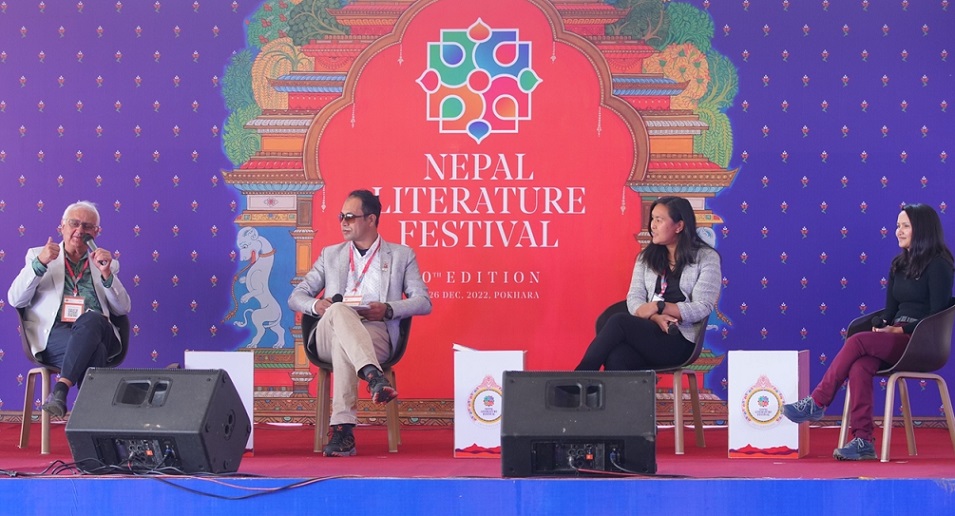
The day kicked off with two very different sessions – one on peaks and mountains and the other on rural local level leadership. The session in the Bhupi Hall featured mountaineer Pasang Lhamu Sherpa Akita, journalist Kanak Mani Dixit, and surveyor Khimlal Gautam in conversation about mountaineering, moderated by former journalist and Everest summiteer herself Shailee Basnet. The discussion featured numerous nuggets of information from both Gautam and Dixit while Akita drew upon her own climbing experience to provide insight. A moment of levity came when Akita’s five-year-old son joined the panelists on stage, leading Basnet to comment upon the role of women in mountaineering.
“Women’s bodies are not just for making babies, but also for making history,” said Basnet.
In the Ali Miya Hall, the discussion was being held between Krishnananda Badu, Konjo Tenzing Lama, and Shanta Kumari Angbuhang, moderated by Prakash Dhakal. The conversation focused on local level leadership in rural areas, aptly titled ‘Sudur ka Singhadurbar’.
The next session in the Ali Miya Hall centered around the role of women in the Mundhum, an ancient religious and literary text of the Limbu people. The discussion was held between Jhuma Limbu and Shanti Devi Rai, moderated by Rajat Rai Kirati. The spirited discussion touched upon problematic depictions of women in the Mundhum with explanations as to what those depictions were attempting to portray in the time they were written.
At the same time in the Bhupi Hall, a panel discussion took place around the need for an international airport in Pokhara between Rameshwore Khanal, Birendra Bahadur Deuja, Pradeep Adhikari, and Basanta Raj Mishra, moderated by Prateek Pradhan. The speakers concluded that a second international airport would provide some relief to Tribhuvan International Airport, the country’s only international airport, and would also help boost tourism in Pokhara.
In the Ali Miya Hall, the next programme was not a discussion but a poetry recitation. Numerous individuals of varying age groups came forward to recite their poetry to a cheering audience. Meanwhile, in the Bhupi Hall, three winning stories from the 12Khari short story competition were discussed. The speakers were Nabin Abhilashi, Ramesh Jung Thapa, and Rumu Neupane.
The session that followed the discussion on short stories also concerned fiction, this time the fiction of Parijat. Three speakers – Khagendra Sangraula, Govinda Giri Prerana, and Sneh Sayami – discussed Parijat’s writing and touched upon where she had been misunderstood by readers and critics.
“Parijat was not someone who was able to take criticism of her thoughts, personality, and creations very well,” commented Sangraula.
In the Ali Miya Hall, the session concerned a very important issue, that of libraries and why they were more important than ever in our time and age. The speakers for this session were Anuradha, Indira Dali, and Jasna Gurung, moderated by Bimal Acharya. Pertinent questions like why politicians never raise the issue of building libraries were raised during the spirited discussion.
The Bhupi Hall was then host to one of the most awaited sessions of the Festival – Booker Prize winner Shehan Karunatilaka in conversation with Shivani Singh Tharu. In the conversation, Karunatilaka elaborated on his winning book, The Seven Moons of Maali Almeida, shedding light on the genre and style he had chosen.
“I am attracted to absurdity,” he said. “There is a lot of absurdity in Sri Lanka.”
The next session in the Ali Miya Hall concerned film criticism and why it is necessary. The session speakers were Anup Subedi, Swastima Khadka, and Dipendra Lama, moderated by Suraj Subedi.
“Reviews develop critical consciousness in society,” said Subedi in response to a question on why film criticism was necessary.
This session was followed by yet another eagerly awaited discussion between Gagan Thapa and Buddhisagar in the Ali Miya Hall. The discussion had a packed audience as hundreds of people showed up to hear the two popular personalities speak about the city of Kathmandu. Buddhisagar’s new book, Eklo, deals with loneliness in the city and Thapa is a long-time Member of Parliament from Kathmandu, so the two personalities spoke about what is common to them both at this time.
“Sometimes I feel like Kathmandu is a transit, people come in a hurry and stop for a while before they go somewhere else,” said Thapa.
One session planned for the day with speakers Birendra Bahadur Basnet and Vijay Kumar had to be cancelled due to a tragedy. Speaker Basnet’s father, the honourable Surendra Bahadur Basnet, unfortunately passed away earlier on Sunday. Bookworm Foundation, the organiser of the Nepal Literature Festival, expressed condolences and duly cancelled the session.
The day as usual ended with a musical night, this time the fusion stylings of guitarist Anil Shahi. With the audience grooving to Shahi’s funky tunes, the fourth day of the Nepal Literature Festival 2022 came to a close.